
Extended paper#
Numerical optimization of aviation decarbonization scenarios: balancing traffic and emissions with maturing energy carriers and aircraft technology
Ian Costa-Alves1,2, Nicolas Gourdain1, François Gallard2, Anne Gazaix2, Yri Amandine Kambiri1,3, Thierry Druot3
1 Aerodynamics, Energetics and Propulsion Department, ISAE-SUPAERO, Toulouse, France — 2 Multidisciplinary Optimization Competence Center, IRT Saint Exupéry, Toulouse, France — 3 Conceptual Airplane Design and Operations, ENAC, Toulouse, France
Note
This section is the web version of the companion paper, published as:
Costa-Alves I., Gourdain N., Gallard F., Gazaix A., Kambiri Y.-A., Druot T. (2026).
Numerical optimization of aviation decarbonization scenarios: balancing traffic and
emissions with maturing energy carriers and aircraft technology. Applied Energy, 412,
127631. doi:10.1016/j.apenergy.2026.127631.
The LaTeX sources are kept in the repository under docs/paper/latex_src/.
Abstract#
Despite being considered a hard-to-abate sector, aviation’s emissions will play an important role in long-term climate mitigation of transportation. The introduction of low-carbon energy carriers and the deployment of new aircraft in the current fleet are modeled as technology-centered decarbonization policies, while supply constraints in targeted market segments are modeled as demand-side policies. Shared Socioeconomic Pathways (SSPs) are used to estimate trend-mitigation traffic demand and to limit the sectoral consumption of electricity and biomass. Mitigation scenarios are formulated as optimization problems, and three applications are demonstrated: no-policy baselines, single-policy optimization, and scenario-robust policies. Results show that the choice of energy carrier is highly dependent on assumptions regarding aircraft technology and the background energy system. Across all SSP-based scenarios, emissions peak by around 2040, but achieving alignment with the Paris Agreement requires either targeted demand management or additional low-carbon energy supply. The use of gradient-based optimization within a multidisciplinary framework enables the efficient resolution of these nonlinear, high-dimensional problems while reducing implementation effort.
Highlights#
Optimization framework links SSP scenarios with detailed aircraft technology;
Fleet replacement and demand saturation leads to emissions peak around 2040;
Impact of alternative aircraft requires extending analysis beyond 2050;
Respecting +2°C carbon budgets requires demand caps or extra energy availability;
Policy optimization was prohibitive without speedups from numerical methodology.
Keywords: Multidisciplinary Optimization; Low-carbon fuels; Aircraft design; Integrated Assessment Models; Shared Socioeconomic Pathways
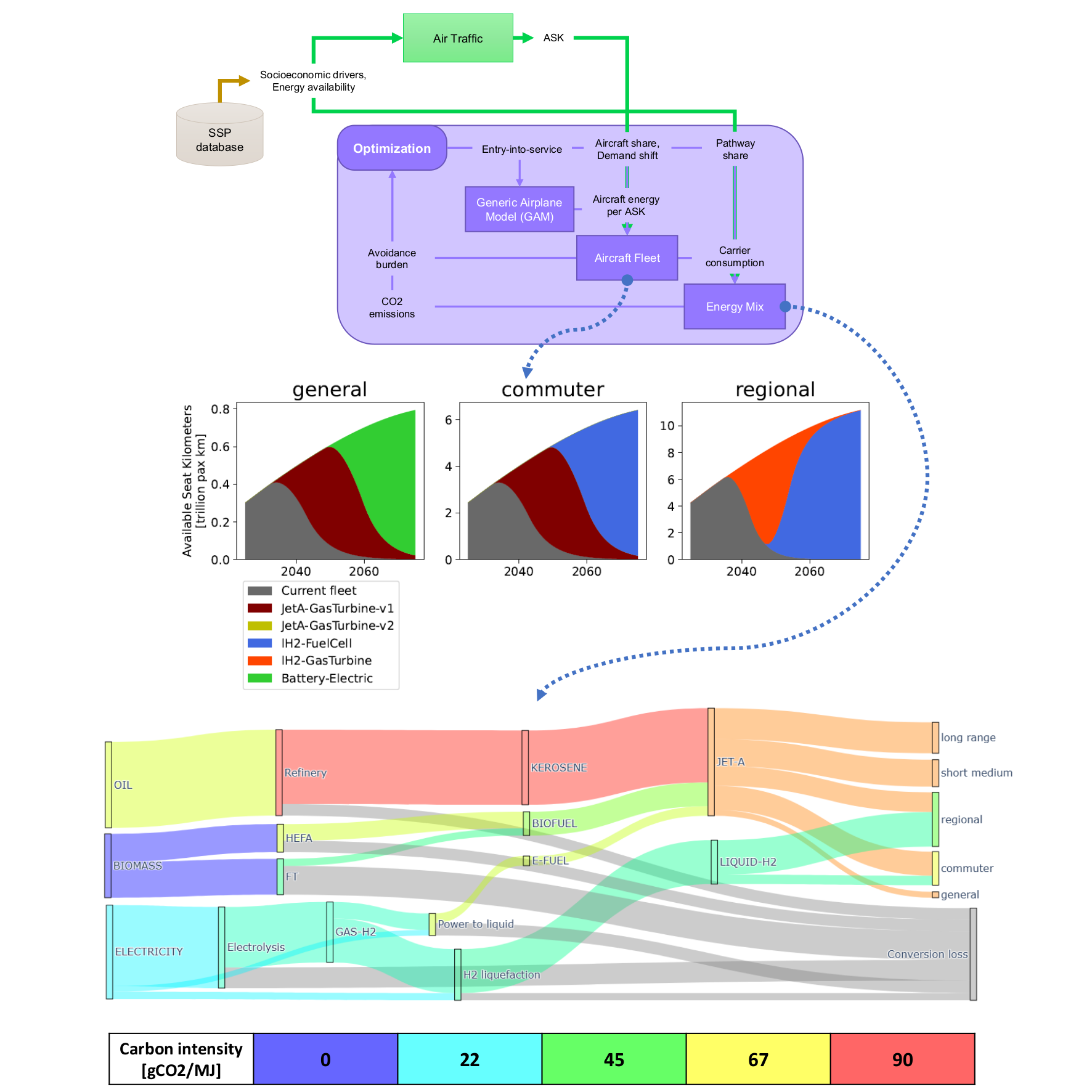
Fig. 1 Graphical abstract.#
Acronyms#
- AD
Automatic Differentiation
- ASK
Available Seat Kilometers
- ATJ
Alcohol-to-Jet
- BtL
Biomass-to-Liquid
- EIS
Entry-Into-Service
- FD
Finite Differences
- FT
Fischer-Tropsch
- GAM
Generic Airplane Model
- GDP
Gross Domestic Product
- HEFA
Hydroprocessed Esters and Fatty Acids
- IAM
Integrated Assessment Model
- IPCC
Intergovernmental Panel on Climate Change
- JIT
Just-In-Time
- LH2
Liquid hydrogen
- MDO
Multidisciplinary Optimization
- PtL
Power-to-Liquid
- RCP
Representative Concentration Pathway
- RPK
Revenue Passenger Kilometers
- SAF
Sustainable Aviation Fuel
- SSP
Shared Socioeconomic Pathways
- TLAR
Top Level Aircraft Requirements
The mathematical symbols used throughout the models are collected in the nomenclature.
Code availability#
All the scripts and data required to reproduce the results from this work are openly available in iancostalves/noads.
Acknowledgements#
Gratitude is extended to the Conceptual Airplane Design and Operations (CADO) team at École Nationale de l’Aviation Civile (ENAC), to the Aviation, Climate, Environment (ACE) group at ISAE-SUPAERO, and to the Institute for Sustainable Aviation (ISA) for their support, assistance, and fruitful discussions. The Generic Aircraft Design Model (GAM), provided by the CADO team, was essential for enabling modeling and analysis of alternative aircraft designs. The AeroMAPS platform, developped by ISAE-SUPAERO and ISA, was reponsible for laying the groundwork upon which this research was built. Special thanks to Pascal Roches, Nicolas Monrolin, Thomas Planès, Scott Delbecq, Antoine Salgas, Florian Simatos, Laurent Joly, and Xavier Carbonneau for their sharp insights, support, and collaboration.
Also, the authors thank the Multidisciplinary Optimization Competence Center at IRT Saint Exupéry, for their availability and support with the methodological developments that preceded this research. Special thanks to Matthias De Lozzo, and Antoine Dechaume for their aid with repository maintenance and thorough code reviews.
Funding sources#
This work was supported by the Occitania region, ISAE-SUPAERO, and IRT Saint Exupéry.