
Comparison with literature#
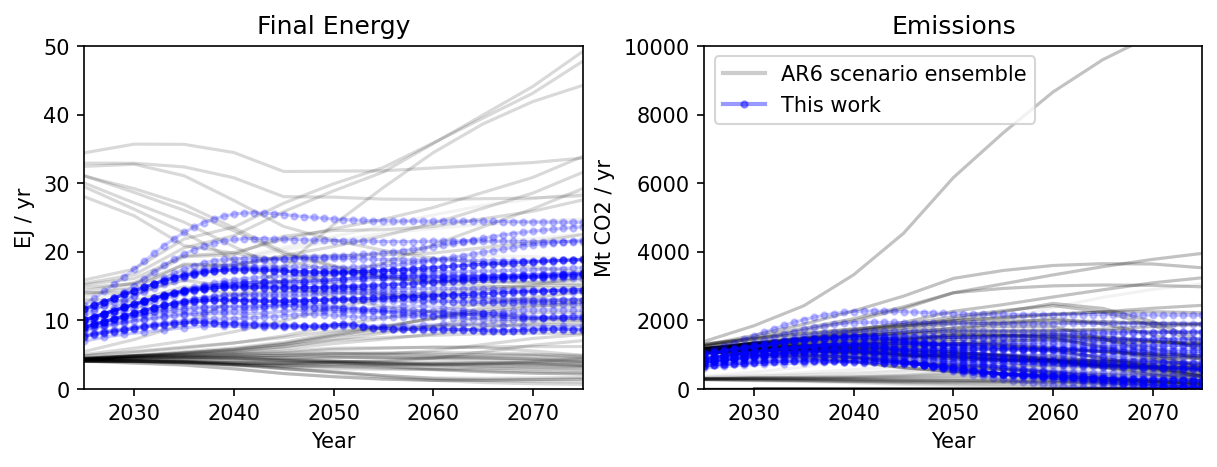
Fig. 33 Comparison of aviation final energy demand and direct CO2 emissions between the scenarios developed in this work and the AR6 scenario ensemble [1]. The AR6 shaded envelope reflects diverse assumptions across models regarding aviation scope, demand growth, efficiency gains, and fuel transitions. The trajectories from this study remain within the ensemble’s range through mid-century, while the stronger long-term decline results from explicitly modeling per-capita demand saturation and full fleet renewal.#
Fig. 33 contrasts aviation’s projected final energy use and emissions from the scenarios generated in this work against the AR6 scenario ensemble. The AR6 ensemble exhibits substantial variation, reflecting divergent modeling assumptions regarding aviation scope (international versus domestic, commercial operations, freight inclusion), demand growth trajectories, efficiency improvements, and alternative fuel adoption pathways. The scenarios developed in this study fall within the inter-model spread of the AR6 ensemble for both energy consumption and CO2 emissions through approximately 2050, demonstrating broadly consistent near- to mid-term dynamics.
Beyond 2050, the present work projects lower energy and emissions compared to much of the AR6 ensemble. This divergence stems primarily from the incorporation of demand saturation effects—as per-capita incomes rise according to SSP narratives, the logistic demand model captures the stabilization of air travel propensity at high income levels, rather than assuming continued growth. This comparison validates the plausibility of the scenarios presented in this work, as they remain consistent with the AR6 range while providing additional insight through explicit modeling of demand saturation dynamics, technology-specific aircraft performance, and resource constraints.
Reproduce this comparison#
The AR6 overlay figure is produced by the following script, which loads all the pre-computed optima shipped with the repository:
Validation of NOADS results against the AR6 scenario ensemble