
Optimization#
The scenario families studied in the paper, each optimized with the same gradient-based formulation: the fossil-only baseline, drop-in sustainable aviation fuels, breakthrough aircraft architectures, and a policy robust to several climate futures, followed by a validation against the AR6 scenario ensemble.
The run_*.py scripts reproduce each optimization from scratch (hours of
compute); the plot_compare_*.py scripts load the pre-computed optima shipped
with the repository and reproduce the comparison figures.
Baseline (fossil kerosene only)#
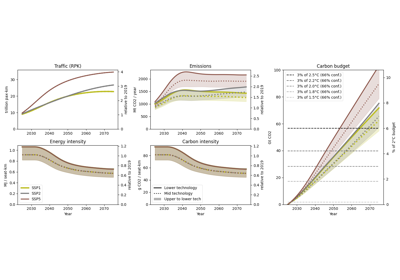
Optimization using only fossil kerosene — no alternative fuels, no new aircraft types. This establishes the counterfactual: what happens if aviation does nothing?
Each run script optimizes for a single background scenario (SSP1-1.9, SSP2-2.6, or SSP5-4.5) across three technology levels (lower, mid, upper). The comparison script gathers all results and plots cross-scenario trends.



Drop-in SAF scenarios#
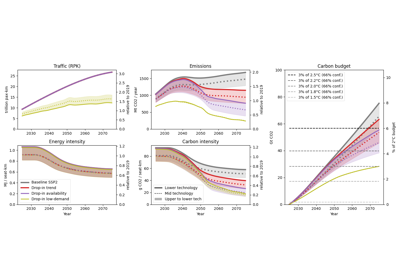
Optimization with drop-in sustainable aviation fuels (HEFA, Fischer–Tropsch, ATJ, Power-to-Liquid), all kerosene-compatible. Four variants are tested under SSP2-2.6: baseline reference, trend resource allocation, preferential energy allocation, and low-demand formulation.
Each run script executes a single variant across three technology levels. The comparison script gathers all variants and plots trend and jet fuel composition comparisons.

Drop-in reference: SSP2-2.6 baseline (fossil kerosene only)



Breakthrough aircraft scenarios#
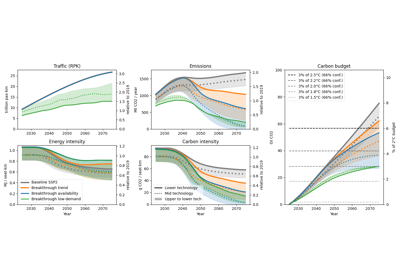
Optimization with all propulsion architectures unlocked: hydrogen gas turbine, hydrogen fuel cell, battery-electric, plus drop-in SAF. Four variants are tested under SSP2-2.6: baseline reference, trend, preferential energy, and low-demand formulation.
Each run script executes a single variant across three technology levels. The comparison script gathers all variants and plots trends, jet fuel composition, and fleet energy carrier breakdowns.

Breakthrough reference: SSP2-2.6 baseline (fossil kerosene only)

Breakthrough aircraft: preferential energy allocation


Robust policy optimization#
Find a single policy that is feasible across multiple SSP2 climate futures (SSP2-1.9, SSP2-2.6, SSP2-3.4) simultaneously. Two variants: trend resource allocation and low-demand formulation.
Each run script executes a single robust variant. The comparison script gathers both and plots multi-scenario results.

Robust policy: low-demand formulation across SSP2 variants

Robust policy: trend resource allocation across SSP2 variants
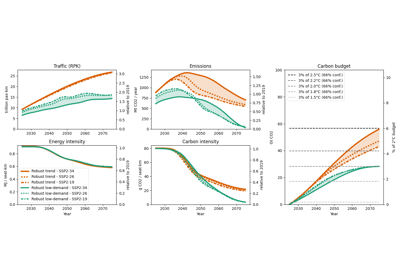
Robust policy: comparison of trend vs low-demand variants
Validation against AR6 ensemble#
Overlay NOADS optimization results against the IPCC AR6 integrated assessment model ensemble to validate that trajectories fall within the expected range for final energy and CO₂ emissions.
Validation of NOADS results against the AR6 scenario ensemble