Background scenarios#
The Shared Socioeconomic Pathways (SSP) were introduced between IPCC’s 5th and 6th Assessment Report (AR5 and AR6) as a way to bridge the socioeconomic dimension of mitigation into climate assessments [8]. These scenarios are formulated based on qualitative stories first, which define high-level assumptions that steer IAM simulations into different possible futures regarding economic development, demographics, energy production, and land-use. Each SSP is created from a storyline to represent a consistent underlying logic to the depth of socioeconomic changes that societies are expected to have:
SSP1: Sustainability – Taking the Green Road (Low challenges to mitigation and adaptation): “The world shifts gradually, but pervasively, toward a more sustainable path, emphasizing more inclusive development that respects perceived environmental boundaries. Consumption is oriented toward low material growth and lower resource and energy intensity” [47].
SSP2: Middle of the Road (Medium challenges to mitigation and adaptation): “The world follows a path in which social, economic, and technological trends do not shift markedly from historical patterns. Global and national institutions work toward but make slow progress in achieving sustainable development goals” [48].
SSP5 Fossil-fueled Development – Taking the Highway (High challenges to mitigation, low challenges to adaptation): “This world places increasing faith in competitive markets, innovation and participatory societies to produce rapid technological progress and development of human capital as the path to sustainable development. At the same time, the push for economic and social development is coupled with the exploitation of abundant fossil fuel resources and the adoption of resource and energy-intensive lifestyles around the world” [49].
After the adoption of the Paris Agreement, studies focused on the investigation of pathways limiting warming to 1.5°C [50] in the context of the Special Report on Global Warming of 1.5°C (SR1.5). From then until AR6, significant work has been done in improving the modeling of energy and transportation technologies, and in multi-model studies covering scenarios from extrapolation current policy trends and the implementation of NDCs, all of them are made available in the AR6 scenario database [1], which is used to provide for scenario-dependent inputs.
From each baseline SSP, mitigation scenarios are introduced by incorporating varying mitigation strategies and are named according to a target radiative forcing by the end of the century, these are made to match scenario emissions to a Representative Concentration Pathway (RCP), which are used in the analysis carried by the IPCC Working Groups 1 and 2. These scenarios are then incorporated by main modeling groups, each resposible for one IAM, forming an SSP-RCP-IAM matrix (see [50]).
The scenario database from the 6th IPCC Assessment Report is used to provide for inputs for future indicators of socioeconomic drivers, and energy system background [1]. The choice of scenario determines: the background population and GDP of the entire economy, affecting future traffic; the total energy production for biomass and grid electricity (considered further as primary energy inputs to the aviation energy system), as well as the associated electricity emission intensity (Fig. 3).
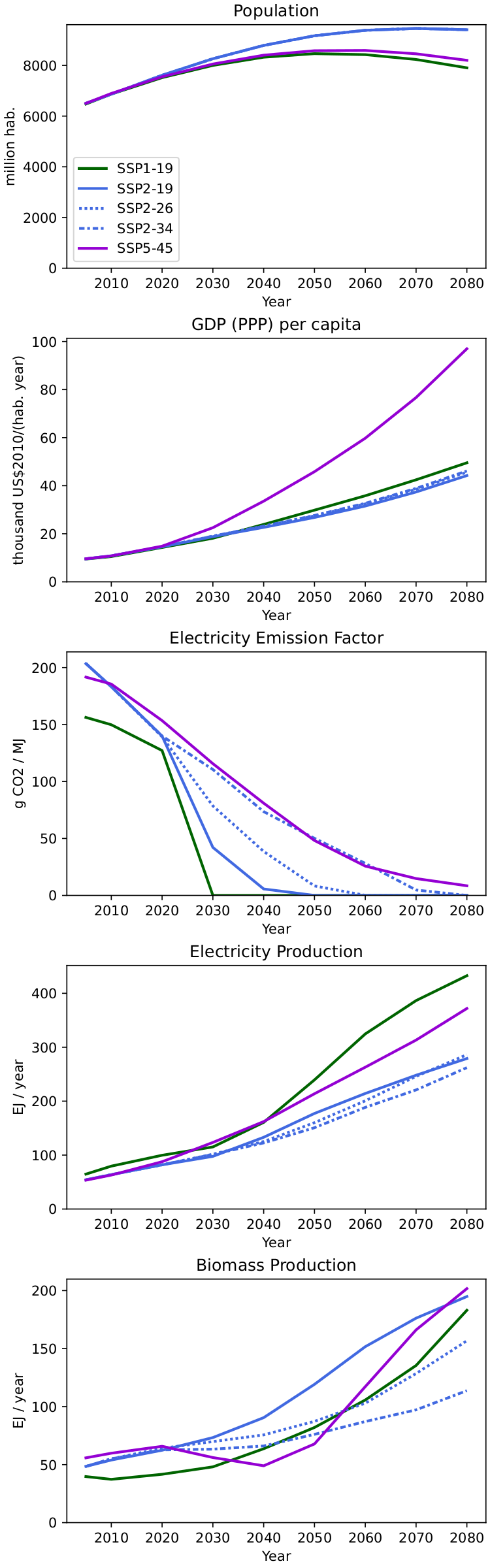
Fig. 3 Scenario-dependent inputs from the AR6 database: population, income per capita, emission factor of grid electricity, electricity production, and biomass production. Source [1].#
The simulated results, are based on scenarios: SSP1 with RCP 1.9 from model WITCH-GLOBIOM 3.1, SSP2 with RCP’s 1.9, 2.6, and 3.4 from MESSAGE-GLOBIOM 1.0, and SSP5 with RCP 4.5 from REMIND-MAgPIE 1.5. Then in the validation of the final results, the aviation sector’s final energy and emissions are compared with the entire scenario ensemble from models IMAGE 3.2, REMIND-MAgPIE 2.1-4.3, REMIND-Transport 2.1, and AIM/Hub-Global 2.0.
Reproduce these figures#
The background-scenario inputs (Fig. 3) and the AR6 aviation output ensemble used for validation are produced by the following example, which reads them directly from the shipped AR6 database export: